


- Best eSIM for Visitors to the USA in 2026 - May 23, 2026
Landing at JFK with no signal is automatically a bad start to any trip. You can’t pull up a map, text anyone you’ve arrived, or get a ride: and the roaming plan your home carrier wants to sell you (if they have one) won’t always fix that cheaply or quickly.
Instead of scouring the airport for a kiosk, prising open your cell phone’s SIM tray, and inserting a physical chip in the hope it works, travelers can instead download an eSIM in advance and get connected to a domestic carrier in the USA as soon as their plane touches down.
The market for US visitor eSIMs has grown rapidly, particularly since the U.S. is co-hosting the FIFA World Cup in 2026. Making the right choice means knowing which one will hold up well in real-world conditions with the right coverage, features, and price.
I’ve compared some of the most popular U.S. eSIM options on this criteria and here’s what I found.
Why use an eSIM when visiting the U.S. and not a ‘data passport’?

Your carrier in your home country may offer roaming if you try to use your cell phone in the States, or at least allow you to purchase a virtual ‘data passport’ with a certain amount of mobile data or call minutes, but this isn’t always the most affordable or convenient option.
For example, the major UK carrier EE currently charges pay-as-you-go customers £1.20 ($1.60) per minute for calls made when roaming in the USA and 60 pence (80 cents) per text message.
Carriers must also offer a ‘data passport’ that can be purchased as an add-on to your existing subscription to allow roaming in the U.S., but these are unlikely to offer the same features as a domestic eSIM, like a US number, and are likely to be more expensive.
Roaming agreements also mean that you’re almost certainly going to be piggybacking on another carrier’s infrastructure rather than connecting directly to a US carrier. That means you might encounter issues when switching between networks, or even potentially find that your traffic is throttled or deprioritized behind its main customers.
Note, there’s a difference here between a carrier in your home country offering an expensive roaming bolt-on, and domestic carriers in the USA offering special subscriptions for visitors beyond their usual domestic plans.
For example, Visible by Verizon is currently offering a special eSIM ‘Travel Pass’ for pre-order that lets you use data on the carrier’s 5G network along with unlimited talk/text within North America. I’ll outline this in more detail later in this guide.
Before you leave, check device compatibility
While eSIMs are generally much more convenient to download and install than physical SIMs, there’s an important caveat: not all devices support them, so you should check carefully before buying.
For Apple users, if you have an iPhone XS (released in September 2018) or newer, then your device can almost certainly download and use eSIMs.
For Android lovers, Samsung Galaxy S20 and newer, Google Pixel 3 and newer, and most 2022+ flagships from other brands are compatible. You may need to check with your provider to be sure, as the same handset may or may not support eSIMS depending on where it was manufactured.
Your cell phone must also be carrier-unlocked to make use of a third-party eSIM. If you bought it through a carrier payment plan, check with them before trying to install any new SIMs.
Top mistakes visitors make when choosing an eSIM for the USA
Buying on advertised data volume alone
A carrier’s site may say that it offers, say, 20 GB over 30 days, but there are likely caveats. For instance, hotspot data may not be included. If it is, it may be drawn from a separate, smaller pool, meaning you may have issues tethering your laptop.
Failing to check what “unlimited data” really means
This is a word that gets thrown around a lot by eSIM providers for travelers to the U.S., but you need to drill down into the details. If a carrier throttles your speed after a certain ‘fair use’ threshold to 512 Kbps, for instance, then you’ll find it difficult to do bandwidth-intensive activities like video calling people back home.
Not checking whether international calls/texts are included
A lot of domestic eSIM plans will include unlimited calls or texting within the U.S., and sometimes Canada or Mexico too. But if you’re not from one of those countries, you’ll likely want to stay in touch with loved ones back home. Most eSIMs for travelers are data only, so don’t include a U.S. telephone number or call allowance. Check with your chosen provider before signing up if you plan to make regular telephone calls and/or send SMS internationally.
Buying the cheapest eSIM plan available
Traveling to the United States can be expensive, but the last thing you want is to run out of data mid-trip, particularly if you have a long bus ride ahead or are in an unfamiliar location. Think carefully about how you’ll use the Internet on your travels, such as for streaming shows or video calling, then budget for your eSIM plan accordingly.
Forgetting to enable “data roaming” after installing the eSIM
This is a rookie error that I’ve made many times, but it’s the most common reason eSIMs don’t work out of the box. Once the eSIM is installed, go to the cellular settings on your handset to double-check data roaming is enabled.
How I tested these eSIMs
I spent the better part of four months traveling across the U.S. due to a combination of work assignments and personal travel covering Oregon, Washington, Colorado, Wyoming, Montana, West Virginia, and Texas, among others.
My primary device throughout was an iPhone 16 Pro, and I ran multiple eSIMs across that period, testing each one against the same criteria: real-world download speeds in urban and rural settings, hotspot reliability for laptop tethering (a non-negotiable when filing copy on the road), call quality where included, and ease of setup.
Rural stretches were revealing. An eSIM that functions perfectly in Denver, for instance, can fall apart entirely when you move over the mountain passes of Colorado and head into Wyoming horse country. The results I came up with reflect what I actually found, not just the glowing marketing claims you can find on most mobile carriers’ websites.
Bottom Line Up Front
After testing each of the eSIMs listed here, Visible by Verizon’s eSIM Travel Pass is the strongest overall offering for visitors to the US in 2026.
Its biggest selling point is that it runs directly on Verizon’s nationwide 5G network and supports 5G Ultra Wideband (where available). You also get unlimited talk/text within North America and a certain amount of international calling, depending on the duration of your ‘pass’.
Most importantly, it’s the only travel eSIM I discovered when doing this roundup that functions as a true US mobile plan, not just a data pipe. Pricing is straightforward, and there’s a generous daily data cap (2 GB) before speeds are reduced to 3G.
Read on for the full breakdown of all five options.
Visible by Verizon eSIM Travel Pass
- Runs on Verizon’s full 5G network, including Ultra Wideband
- Includes international calling to 85+ countries and unlimited texting to 200+ countries
- Supports US phone calls (unlimited talk/text within North America)
- No option to buy more than 45 days at a time
- 2 GB daily data soft cap before speeds are reduced to 3G
The eSIM Travel Pass was launched in March 2026 specifically for international visitors to the U.S., likely because Visible is an official “connectivity sponsor” of the FIFA World Cup.
There are four duration tiers available, currently these are available for pre-order for $10 less than their standard price:
7-day ($15)
14-day ($25)
30-day ($35)
45-day ($45)
Each plan includes unlimited text within North America, i.e., the USA, Canada, and Mexico, and a certain quota of minutes to call 85+ countries. For example, the 7-day travel pass offers 90 minutes of international calling.
The main reason to choose this eSIM is that Verizon’s infrastructure is one of the most geographically complete in the US, so Travel Pass can access the same 5G Ultra Wideband tier that postpaid Verizon customers use.
Data is unlimited in that there’s no hard cap, but once you go over 2 GB each day, roaming data speeds are reduced to 3G. This should pose no issues for most itineraries involving checking maps, social media, occasional streaming, and hotspot tethering. The travel pass is for a fixed duration, but you can choose to activate it when you arrive over Wi-Fi instead of right away.
Saily
- Backed by NordVPN, so existing subscribers may get a discount
- Built-in security features, e.g., ad-blocking
- One e-SIM can work across multiple destinations, no need to reinstall
- Data only (no calls or SMS)
- ‘Unlimited’ plans throttle speeds after 30 GB
- Plans can’t be topped up via SMS
Saily’s main differentiator is the Nord Security pedigree. If you’re already a NordVPN subscriber, the provider occasionally bundles a free eSIM with new sign-ups.
Otherwise, standard Saily International eSIM plans can be bought for a certain allotment of data over a certain period. Plans start at $3.99 for 1 GB over 7 days to $36.99 for 20 GB over 30 days.
There are also ‘Unlimited GB’ plans that are priced according to duration. For instance, $48.99 for 15 days.
Saily’s main selling point is that if you’re visiting the U.S. as part of a broader trip that includes other countries, you can add data plans to an existing eSIM, saving you the trouble of reinstalling each time.
As you’d expect from something built by Nord Security, Saily eSIMs also come with security features, like blocking ads and trackers, though I didn’t have a chance to test these in-depth. The main drawback is that Saily plans are data only: there are no calls or texts, and if you run out of data, you’ll need a Wi-Fi connection to purchase more.
Airalo
- One of the best-known eSIM marketplaces offering wide coverage
- Competitive pricing for US plans
- Regional plans covering Canada, US, and Mexico for one price
- Slightly complex pricing structure
- No ‘unlimited’ data plans if you also want calls and texts
- Plans must be bought and installed individually for each location
As eSIM marketplaces go, Airalo is one of the most well-known globally, which is why it was the one I chose when I started traveling, as its coverage extends to 190+ countries. You can also buy regional plans that cover areas like North America.
Airalo doesn’t operate its own infrastructure but partners with carriers like T-Mobile and Verizon in the U.S. for data connectivity. As with Saily, plans are for fixed volumes of data for a certain duration.
These start at a reasonable $4 for 1 GB over three days up to $42 for 50 GB over thirty days. Unlike Saily, there are options for different data allowances. For instance, you can buy 3 GB of data over three days for $8.50 as well as pay $4 for 1 GB.
There are also ‘Unlimited’ plans starting at $11.50 for three days. However, unlimited data isn’t available on plans that involve calls and texts. While regional eSIMS will work between designated countries, you’ll also need to delete an existing eSIM and install a new one if you move outside these for continued coverage.
Holafly
- Offers plans with generous fair usage allowance
- Very positive online reviews
- Flexible pricing
- Data only for standard plans
- 1 GB daily hotspot limit can be a real constraint for tethering
- Monthly subscription plans (Holafly Plans) activate immediately
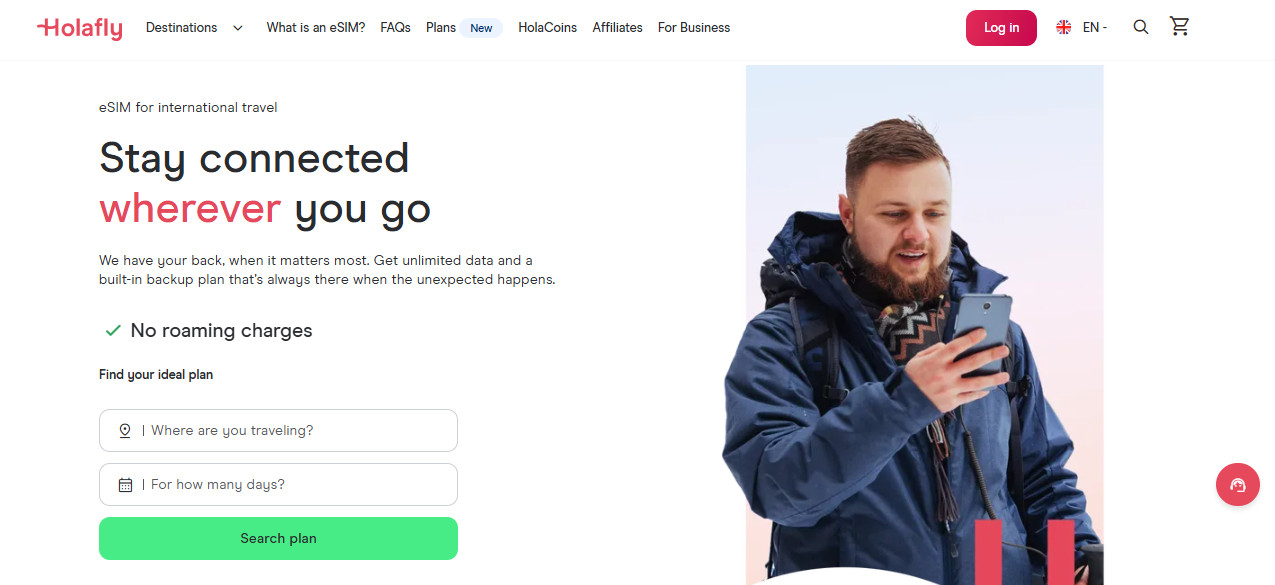
Holafly’s US eSIM is based on a simple (and quite lucrative) premise: truly unlimited data. This contributes to its 4.6/5 star rating on Trustpilot
From reading the fine print, I discovered that the operator ‘reserves the right’ to apply a fair usage policy whereby if you go over 90 GB, they may reduce the speed to between 256-1024KB to avoid affecting other users temporarily, but your speed will be restored within 24 hours.
Still, this is a generous allowance, equivalent to streaming around an hour of HD video every day in a 30-day month. It partners with AT&T and T-Mobile and provides coverage in most of the U.S., though the main site warns that you might have connectivity issues in isolated areas like Page, AZ, or the Grand Canyon.
Plans go from $11.70 for three days to $74.90 for 30 days. This means if you’re planning a longer trip, you’re likely to pay more for a data-only plan versus the likes of Airalo or Saily.
You also only get a certain quota of daily data for hotspot usage, typically limited to 1 GB per day, which can be a major drawback if you plan to tether devices to your cell phone. Plans are activated instantly, so you’ll need to time your subscription carefully so you’re not paying for days before you arrive in the USA.
Ubigi
- Competitive ‘unlimited’ plan pricing
- ‘Smartstart’ means plans can activate on arrival in the U.S.
- Tethering supported
- ‘Unlimited’ plans after a certain allotment of full-speed data (plan dependent)
- Data only
- US data plans don’t cover Alaska
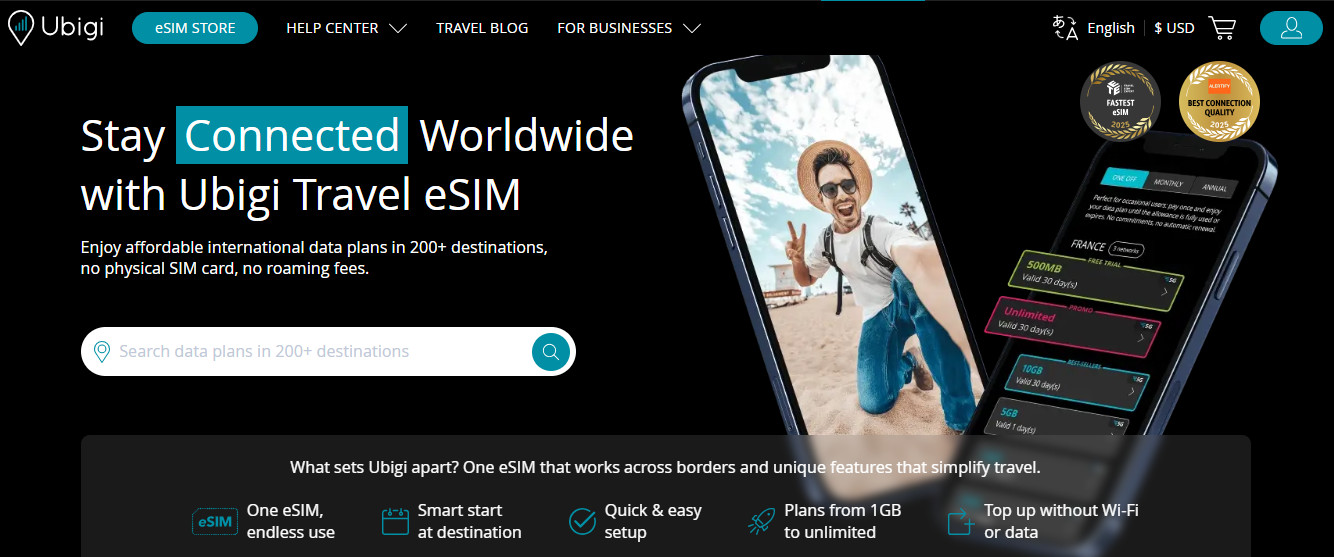
This carrier positions itself as an affordable platform for international data eSIMs.
The pricing page can be a little tricky to navigate, but U.S. data plans start at $2.90 for a 500 MB allowance over 1 day and go to $65 for unlimited data over 30 days. There are also monthly and annual plans if you plan to stay in the States longer. Coverage doesn’t apply to Alaska, but this shouldn’t matter if you’re visiting to attend the 2026 World Cup, as no matches are being played there.
Ubigi’s “SmartStart” feature also gives its eSIMs an edge over competitors like Holafly, as, instead of activating on purchase, they will only be enabled once they connect to a US network.
However, once you hit a certain data threshold (plan-dependent) within your plan’s validity period, your speeds will be throttled. For example, on 30-day unlimited plans, the threshold is set at 60 GB, after which your speed is limited to 2 Mbps. This likely isn’t enough to stream HD video without buffering, but would support daily browsing, such as accessing social media or WhatsApp voice calls.
The Best eSIM for Visitors to the USA in 2026
Of the options reviewed here, Visible by Verizon’s eSIM Travel Pass is the best overall offering for visitors to the U.S. in 2026.
None of the other options here delivers calls, texts, and 5G speeds under a single, transparent price with no hidden fees/taxes. For anyone arriving in the States to see a World Cup match, a long work trip, or even an extended holiday, Verizon’s combination of network depth and the all-in plan structure makes it a solid choice.
Still, there are some use cases that might favor the alternatives. If you’re on a tight budget, for instance, then Airalo’s and Saily’s plans represent the cheapest ways to get connected in the U.S.
Ubigi’s $65 30-day plan with 60 GB of full-speed data before a (still-functional) 2 Mbps throttle kicks in, also represents one of the best pure-data price points of the options here.
Heavy data users who don’t use tethering much may also benefit from Holafly’s 30-day unlimited plan, it has no speed ceiling, unless you go over the generous 90 GB fair use allowance.