



- Comparing 5 Online Degrees for Digital Nomads - October 20, 2026
- Best Bars for a Group Night Out in Philadelphia - August 6, 2026
- Best Travel Pillow for Long Flights - September 10, 2025
Are you looking to build your skills, but don’t know where you’ll be living next year? Want to go back to school, but aren’t sure how that would even work for your life?
An online degree might be just what you need to move forward in your career. That said, a lot of traditional college advice isn’t for working adults, especially those who live on the go.

Learners pursuing a degree while traveling or living abroad are going to have different needs and challenges than other students. Let’s talk through a few things you need to look for if you’re considering an online program and where you can enroll.
Institutions at a Glance:
| Estimated Cost | Term Length | Program Options | |
| SNHU | $42,000 per degree | 8 weeks | Over 200 options |
| WGU | $3500-$4300 per term | 6 months | Varied |
| Purdue Global | $66,000 per degree | 10 weeks | Varied |
| University of Phoenix | $50,000 per degree | 5-6 weeks per course | Varied |
| UoPeople | $7,300 | 9 weeks | Limited |
Factors to Consider:
Asynchronous Delivery and Time Zone Flexibility

If you frequently move time zones or are in a different part of the world from your classmates and instructors, look for an institution that offers flexibility to learn on your own schedule. A crucial part of this is asynchronous program delivery where lectures and other class time instruction is recorded and available to view at any time (and from any time zone).
Deadlines for assignments also need to be meetable for students from all time zones. Choose an institution where deadlines are clearly communicated in advance and have a broad time window in which you can submit your work. For example, at University of the People, the new learning week begins on Thursday at 12:05 am GMT and ends on Wednesday at 11:55 pm.
The same goes for any required exams. As a digital nomad, you need to be able to take your exams or assessments on a flexible timetable. Some institutions require a certain number of proctored exams. Regardless, you should make sure you have a few days within which you can take an exam and make sure you’re prepared and in a quiet location with reliable WiFi before you begin.
International Recognition

Online institutions are not always viewed as highly as they should be. Your institution’s accreditation and reputation matter, perhaps even more so than with a traditional degree
In the US, it’s worth pursuing a degree that is regionally accredited. Not only is this the highest standard of accreditation available, but it also means that your credits could transfer to other programs (for nationally accredited schools, this is not always the case). It’s also a great benchmark to ensure that the curriculum you’re completing is of comparable rigor to what you’d learn from a traditional degree.
It’s also a good idea to look up outcomes in your field and make a note if a particular institution has a strong reputation for what you want to study.
Career Alignment

Even if a degree is affordable and accessible, it will still be a big investment of your time and effort. To maximize that return, your degree should be as relevant to the life you want to live as possible.
Some of the most popular careers for digital nomads include:
- Computer science and software engineering
- Information technology and cybersecurity
- Data science and analytics
- Graphic design or UX/UI Design
- Digital marketing or communications
- Business administration
- Writing, journalism, or translation (degrees related to English, journalism, or publishing)
If your path isn’t listed here, you should still look at an institution’s course catalog to see if they have a relevant program.
For any of these careers, it’s worth noting that remote employers (or clients) will usually value a portfolio or a proven track record over the name of your university. Your degree should give you opportunities to demonstrate your skills, but having one isn’t a substitute for work experience or project opportunities.
Cost

How much money you’re investing in your degree matters whether you’re doing it in one place or multiple. Because of their nature (and how different students pursue online degrees at different paces), online universities tend to structure their tuition differently than traditional universities.
That means you’ll need to look closely at how any institution you’re considering bills its tuition (whether that’s by term, by credit, or by course). You’ll also want to explore all possible options for reducing your cost, including the school’s transfer credit and credit-by-proficiency policies as well as any financial aid options available to you.
Institutions for Online Degrees:
Southern New Hampshire University (SNHU)

With over 200 degree programs, SNHU boasts the broadest program catalog out of any popular online institution. All of the career paths we mentioned above (programming, business, marketing, and writing) all have relevant degrees available at SNHU, as do dozens of other fields like education and social work.
Terms at SNHU are 8 weeks long, and there are six possible start terms, so you can begin and end studies on whatever timeline works for you. There are no live class times, so the flexibility you’ll need is there, and deadlines usually fall on Thursdays or Sundays.
SNHU charges $354 per credit hour, which adds up to about $42,000 for the whole degree if you’re not transferring previous credits. That is cheaper than the sticker price of a traditional degree, but it would add up over time if you’re a first-time degree seeker.
Western Governors University (WGU)

WGU is another popular option for working adult learners; however, it is currently only available to U.S. residents. This may disqualify it for some readers, but if you plan to reside primarily in the U.S., it’s worth looking into.
WGU offers multiple computing degrees for programmers as well as degrees in data analytics, marketing, and UX design. WGU has start terms every month; these terms are six months long, and you pay tuition by the term. Depending on which degree you’re doing, that’ll be anywhere from $3500-$4300 per term. That makes it highly beneficial for your budget if you’re able to complete a WGU at a full-time pace.
WGU emphasizes competency-based learning, so it’s possible to test out of many degree requirements by passing an exam. Grades at WGU are generally based on either performance assessments (projects, papers, or presentations to apply what you’ve learned) or objective assessments (proctored exams).
Purdue Global

Given that it’s affiliated with a large, prestigious public university system in Indiana, Purdue Global might get a boost in terms of prestigious online degrees. Purdue charges $371 per credit hour; however, they run on a quarter-hour system rather than a semester-hour system. That means it takes 180 credit hours to earn one of their degrees, which makes Purdue Global the most expensive option (up to $66,000) we’ve talked about so far.
Purdue Global has 10-week terms (similar to SNHU) and offers some competency-based assessments (similar to WGU). Some degrees require proctored exams while others allow you to demonstrate mastery of the material through regular projects, quizzes, and other assessments. Purdue’s degrees might be the best fit for on-the-go professionals in IT/cybersecurity, data analytics, or marketing.
University of Phoenix

When people think “online college”, University of Phoenix is probably the first name that comes to mind. While Phoenix has marketed itself widely, there are a few factors worth thinking about before enrolling.
They charge a consistent $398 per credit for undergraduate courses, or $1364 per course. Without transfer credit, that puts your cost at almost $50,000. Phoenix is regionally accredited by the Higher Learning Commission (HLC), but it’s worth noting that it is also the only for-profit school on our list. Since these institutions don’t invest all of their revenue back into student support, that’s a factor worth considering.
University of Phoenix students typically take one class at a time, with each class lasting 5-6 weeks. If you benefit from focusing on a single subject at a time and can invest 15-20 hours per week on that subject, their schedule could work well for your learning style. In terms of nomad-friendly careers, they are known for their computing and business degrees.
University of the People
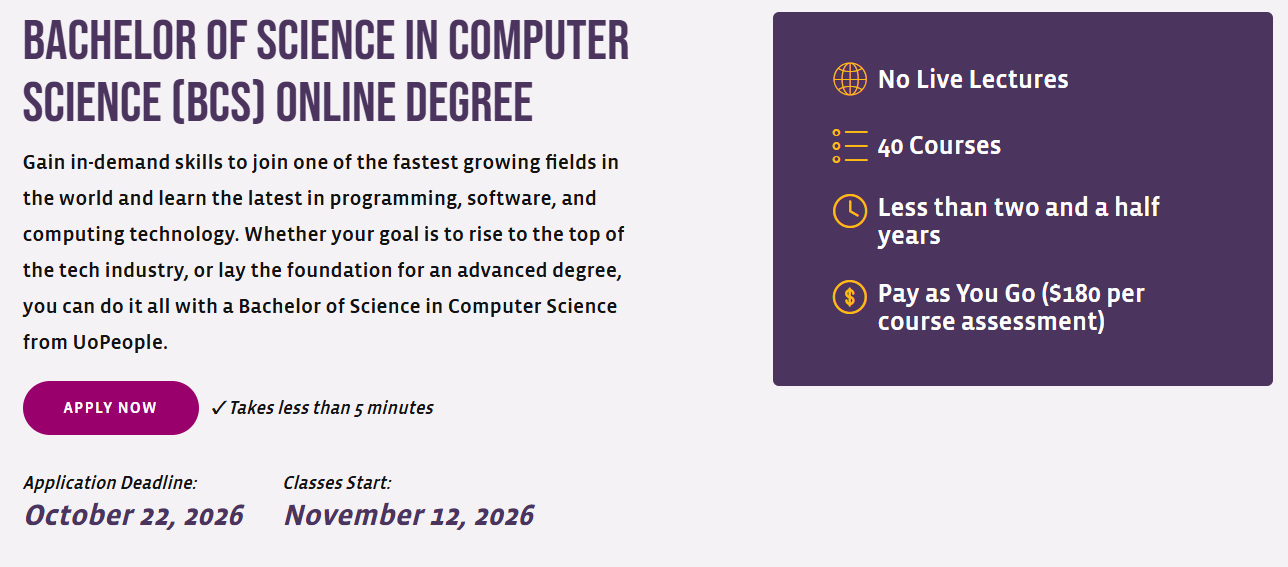
University of the People is a not-for-profit, online university that offers all of its degrees tuition-free. The only things you have to pay for at UoPeople are course assessment fees and your application fee. For example, the cost of their Computer Science degree comes out to just $7,300. That makes University of the People the most affordable option on the board, and it could be even less if you transfer previous college credits.
University of the People’s degree options are more limited than other institutions, but if you’re looking for an accessible, affordable degree and can connect one of their programs to your career, it could be a great fit. Similarly to SNHU, they run on eight-week terms and offer flexible scheduling, with only some courses requiring proctored exams. Their Computer Science, Business Administration, Health Science, and General Studies degrees are popular and accessible options, as are their certificate programs in cybersecurity, data analytics, and game design.
In Conclusion

The most important thing to remember is that your degree needs to make sense for your life. As a digital nomad, you’re already used to structuring life on your own terms. You shouldn’t have to put your life on hold in order to start the next chapter of your career. With the right online institution, there’s no need to.
Purdue Global is your best prestigious option, while WGU is great for fast-paced learners, and University of Phoenix works if you prefer to study one class at a time. If you’re looking for access and affordability above all else, University of the People is your best bet. If you have a specific program in mind that’s more niche, SNHU might be the most likely to have it; you should always check an institution’s website to learn more about what it’s like to do any particular program.