

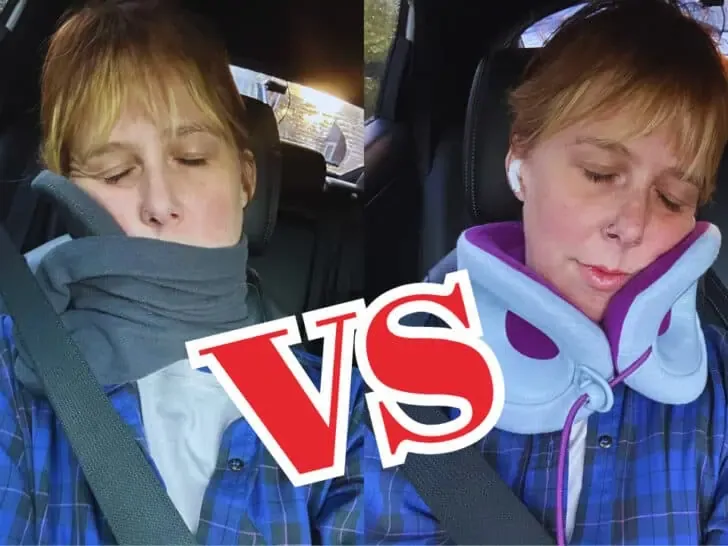

- TRTL vs Cabeau Evolution X - October 28, 2025
I’m heading to Spain soon – Valencia, to be exact. And as much as I’d love to be stretched out in a lie-flat seat sipping cava, reality check: my ticket is squarely in economy. Which means if I want any hope of arriving rested enough to wrangle luggage along with the nine-hour time difference, I need a travel pillow that actually works.
For years, I thought travel pillows were just hype. I’d grab my kids the cheap inflatable ones at the airport shop, then twist up a sweatshirt around my own neck and pretend it was fine. On the short hops (like Portland to LA), I could get by. But with 15 hours of travel staring me down, it’s clear my pillow strategy needs a serious upgrade.
And if you’ve ever been that person trying to sleep in an economy seat without a pillow, you know how grim it gets. You fold your arms on the tray table (instant chiropractor bill), lean against the window (neck cramp city), or try the awkward “head back, mouth open” move that guarantees your seatmate will side-eye you all flight. I’ve done all of these. None of them works. Which is why, this time, I wanted to take my pillow game seriously.
So I decided to put two of the biggest names in travel pillows to the test: TRTL vs. Cabeau. Both swear they’ll save your neck on long flights – now it’s time to see if they actually deliver. Since I don’t actually leave for Spain until October, I’ve been using long car rides as my testing ground – a three-hour drive isn’t quite a seven-hour flight, but if a pillow can keep my neck happy for hours in a car, it’s a good sign it’ll survive economy class.
The TRTL Pillow
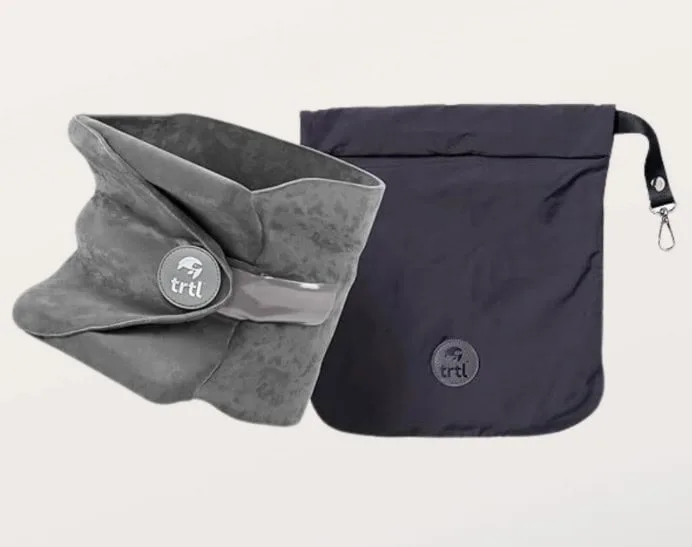
TRTL isn’t your typical U-shaped pillow. It’s basically a fleece wrap with a hidden plastic brace inside. You velcro it around your neck and it props your head like you’re leaning against an invisible shoulder.
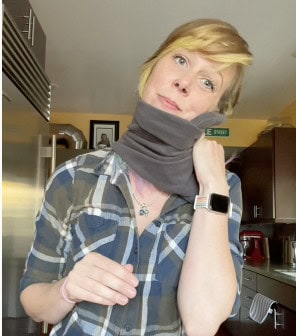
Unboxing it was almost funny – it looks less like a pillow and more like a neck brace wearing a scarf. At first, I wasn’t even sure which way to wrap it, and the velcro makes that loud ripping sound every time you adjust it, which isn’t exactly subtle if you’re on a plane. Still, once I figured it out, it felt snug in place.
I tested it in the car for a couple of hours, and while it wasn’t perfect, it did keep my head from constantly bobbing around.
Here’s what stood out:
- Compact size: It folds almost flat and barely takes up any space in my bag.
- Targeted support: The plastic brace does keep your head from falling forward.
- Soft fabric: the fleece wrap feels cozy at first, especially if you run cold.
Where it fell short was finding – and keeping – comfort. I went down a whole YouTube rabbit hole trying to figure out the “right” way to wrap the TRTL so it didn’t feel like it was pressing on my throat. Once I had it on, the fleece shifted from cozy to smothering, and the single brace only let me lean one direction. By the end of the test, my neck actually felt stiffer than when I started – definitely not the outcome I was hoping for.
On a short flight, you might tolerate it. But the thought of being locked into one position for eight hours? That’s a tough sell.
The Cabeau Evolution X
Cabeau takes a different approach. Instead of a wrap and brace, the Evolution X is built from memory foam that’s contoured to support your head and jaw.
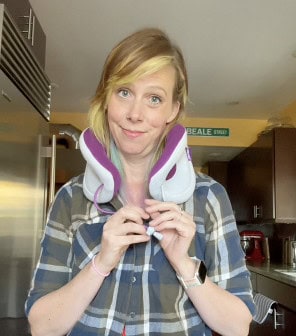
First impression: it actually looks and feels like a pillow you’d want to use. The foam bounces back when you press into it, the raised sides cradle your head, and the flat back means you can rest naturally against the seat instead of being pushed forward.
I tested it in the car too, and the difference was obvious right away – instead of constantly readjusting, I could just relax.
Here’s what stood out:
- Balanced memory foam: firm enough to hold my head up, soft enough that it still felt like a pillow.
- Thoughtful design: raised sides with cooling vents kept my head from flopping and neck cool, while the flat back meant I wasn’t pushed forward awkwardly.
- Game-changing straps: Being able to anchor it to the headrest kept it from sliding around and made it feel more secure.
- Washable cover: easy to freshen up after long trips.
Where it stood out most was consistency. I didn’t have to fight for comfort or keep shifting positions – it just worked. By the end of my test, my neck actually felt better supported than when I started, which is pretty much the whole point of bringing a pillow in the first place.
TRTL vs Cabeau: The Breakdown
After testing both pillows, a few clear differences started to stand out. They may look like they’re solving the same problem, but TRTL and Cabeau approach comfort, portability, and value in totally different ways. Here’s how they stack up once you put them to real use.
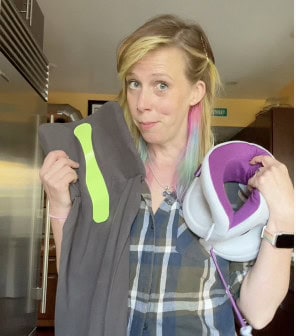
Comfort
This is the category that matters most – because if a travel pillow isn’t comfortable, what’s the point? With TRTL, the design locks you into one fixed angle. If your body happens to like that angle, you’ll be okay for a while. But if not, you’ll find yourself fidgeting, shifting the brace from left to right, and wishing you had more options. After an hour or two, the fleece also starts to feel warm, and not in a cozy blanket way – more in a “why do I feel like I’m overheating?” way.

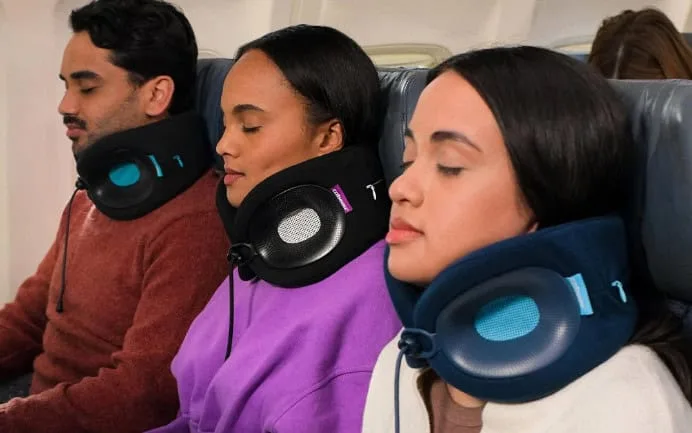
Cabeau, on the other hand, feels like it was built for actual sleep. The memory foam cushions your head without collapsing, the raised sides keep your jaw supported, and the flat back lets you rest naturally against the seat. I didn’t feel that awkward “head shoved forward” thing that so many pillows cause. By the end of my test, TRTL had me stiff; Cabeau had me relaxed.
If comfort is the deciding factor, Cabeau wins this category hands down.
Packability
Here’s where TRTL shines. It folds nearly flat, slides into a backpack pocket, and takes up about as much space as a thin book. If you’re the type who travels with just a personal item and hates anything bulky, this is a major selling point. I tossed it into my work bag alongside a laptop and charger, and it practically disappeared.

Cabeau makes an effort here with its travel case, which compresses the pillow down. It’s much smaller in the case than it looks outside of it, but there’s no getting around the fact that it takes up more room than TRTL. I had to shuffle things around in my bag to make it fit more comfortably.
TRTL takes the point here.
Versatility
TRTL is very much a “what you see is what you get” situation. It props your head in one direction, and that’s about it. Great if you like consistency, but not if you shift positions. Cabeau, though, gives you more flexibility. You can lean to either side, tilt back, or even strap it to different types of seats. It doesn’t lock you into one way of sitting, and that makes a big difference on long hauls where you’re constantly adjusting.

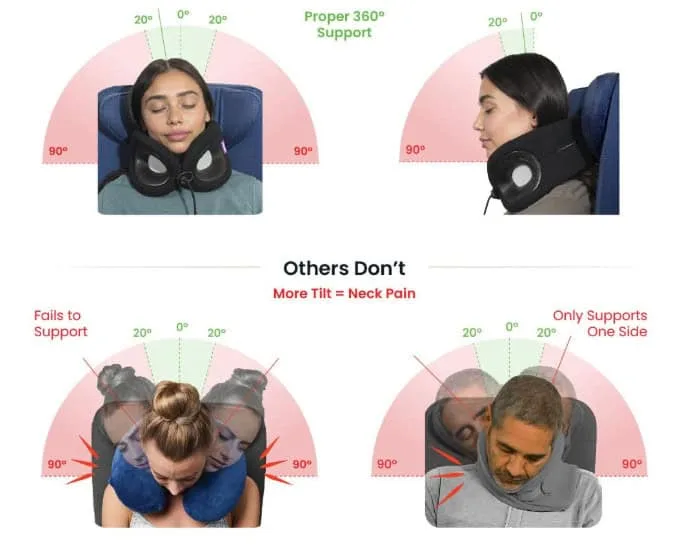
For versatility and adaptability, Cabeau is the clear winner.
Cleanability
Both pillows score well here, but in slightly different ways. TRTL’s fleece wrap is washable, which is handy if you’re someone who eats, drinks, or generally makes a mess while traveling (guilty). After tossing it in the machine, it came out clean, but I noticed it took longer to dry and picked up lint.
Cabeau has a removable, washable cover. I tossed it in with a load of laundry, and it air-dried quickly without losing its shape. The foam inside held up well outside of the cover, too, which is reassuring if you’re planning to use it often.
In this round, it’s a tie – both are easy to keep clean.
Price
This one surprised me. The TRTL comes in at $54.99, while the Cabeau Evolution X is actually cheaper at $49.99. Given the quality and comfort differences, I expected Cabeau to cost more. Instead, it delivered a better performance and saved me a few dollars.




To put it another way: TRTL isn’t wildly expensive, but paying more for less comfort doesn’t feel like a smart trade. With Cabeau, you’re getting the pillow that actually helps you rest, and you’re paying less for it. That’s a win-win in my book.
With the lower price and better performance, Cabeau takes this category without question.
Final Thoughts
At the end of the day, travel pillows aren’t about clever designs or gimmicks – they’re about whether you can actually get some real rest in economy. That’s the only thing that matters when you’ve got a long flight ahead of you and a full trip waiting on the other side.
TRTL does have its place. If you’re a minimalist traveler who wants something flat and light, or if most of your flights are short hops where you just need to avoid a little head bobbing, it can work. It packs down tiny, and for quick naps, it does the job.
But for me – and for anyone else facing red-eyes, long-hauls, or time zone shifts – Cabeau is the smarter choice. It’s more comfortable, more versatile, easier to use, and even a little cheaper. On my car tests, it was the one that left me feeling supported instead of stiff. And when I picture myself stepping off that flight to Spain in October, juggling luggage and a full itinerary, I know which pillow I’d rather have on my side.
So here’s the bottom line:
- If you want the slimmest, lightest option for short flights, go with TRTL.
- If you want to actually sleep and land feeling human, go with Cabeau.
And if you’re planning your own trip – whether it’s a transatlantic flight, a red-eye cross-country, or even just a long drive – do yourself a favor: pack the pillow that makes arriving rested possible.